
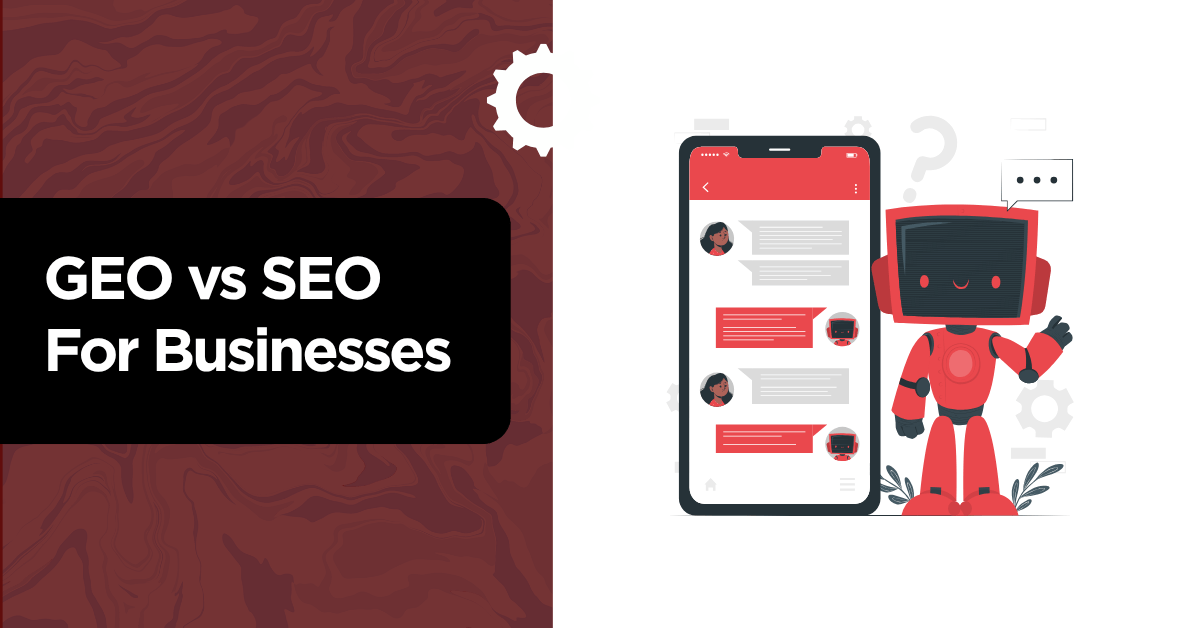
GEO vs SEO for Businesses: Which One is More Profitable?
More people now ask AI chatbots for answers instead of scrolling through blue links on a search page. When someone asks ChatGPT or Google Gemini for a product recommendation, traditional keyword rankings do not guarantee a mention. Brands now fight to get cited inside these AI-generated responses. This new battleground forces marketing teams to weigh old-school search methods against generative engine optimization. That shift has put GEO vs SEO at the center of a lot of marketing conversations, and business owners want a straight answer: Finding the right balance dictates whether your business gets noticed by modern shoppers.
Traditional search optimization relies on ranking web pages through keywords, backlinks, and technical site health. Conversely, generative engine optimization targets AI-powered discovery platforms by structuring information for machine comprehension. Understanding the mechanics of both disciplines allows marketing teams to allocate budget effectively and future-proof their digital presence.
What is GEO?
Generative Engine Optimization (GEO) is the practice of shaping your content so that AI tools can understand it, trust it, and use it to answer questions directly. Instead of trying to earn a spot on a search results page, GEO is about earning a mention, or a citation, inside an AI-generated answer.
How GEO works comes down to how AI models pull information together. When someone asks an AI platform a question, the model scans a wide range of trusted sources, pulls out the most relevant and well-structured pieces, and stitches them into a conversational response. If your content is clear, well-organized, and backed by real expertise, it has a much better shot at being one of those sources.
Optimizing for AI overviews and other AI-generated results usually means:
- Structuring content around real, specific questions people ask
- Using clear headings, short paragraphs, and direct answers near the top of a page
- Backing up claims with credible data, examples, or first-hand experience
- Making sure your site is easy for AI crawlers to read and interpret
Generative AI search optimization also extends beyond your own website. Improving visibility in Perplexity AI and getting cited by Gemini and ChatGPT often depend on how your brand shows up across the wider web, think forums, review sites, and industry publications, not just your own blog. AI tools tend to pull from multiple sources to build a well-rounded answer, so the more places your expertise appears, the better your odds of being cited.
As we move through the year, GEO strategies for 2026 are increasingly centered on AI-driven search rankings, a newer kind of visibility that isn’t about position on a page but about whether you show up in the answer at all.
What is SEO?
Search Engine Optimization (SEO), or what most people think of as traditional SEO basics, is the practice of improving a website so it ranks higher in search engines like Google and Bing. It’s been the backbone of digital marketing for two decades, and it still matters a lot.
Understanding how to rank on Google Search starts with three main pillars:
- On-page SEO: content quality, keyword usage, headings, and internal linking
- Technical SEO: site speed, mobile-friendliness, crawlability, and clean site structure
- Off-page SEO: backlinks and brand authority built from other credible websites
Keyword research for organic search is still one of the first steps in any SEO plan. Knowing what your audience is actually typing into search bars helps you build content that answers their questions directly. From there, a solid on-page SEO checklist: things like optimized title tags, meta descriptions, image alt text, and clear URL structures help search engines understand exactly what a page is about.
Backlink-building strategies remain one of the strongest trust signals in SEO. When credible websites link back to your content, it tells search engines your brand is a reliable source worth ranking higher.
Finally, technical SEO for business websites and organic click-through rate optimization round things out, making sure your site loads fast, works well on mobile, and that your listings in search results are compelling enough that people actually want to click them.
Following SEO best practices for 2026 means treating all three pillars as ongoing work, not a one-time setup.
Joseph Bridges
Designer
GEO vs SEO: The Key Differences
At a glance, GEO and SEO look similar; both are about being found by the right audience at the right time. The differences show up in how success is measured and where visibility actually happens.
SEO is about earning a position on a results page. Success is tracked through rankings, organic traffic, and click-through rate. GEO is about earning a place inside a generated answer. Success is tracked through citations, brand mentions, and how often your content gets referenced by AI tools even if the user never clicks through to your site.
In other words, SEO gets your business discovered. GEO gets your business included in the conversation. That distinction matters even more at the local level. Local SEO vs. local GEO plays out a bit differently. Local SEO still relies heavily on your Google Business Profile, reviews, and location-based keywords, while local GEO depends on how clearly and consistently your business information appears across the web so AI tools can confidently recommend you for “near me” style questions.
Why Do Businesses Need GEO?
Here’s the reality: fewer searches are ending in a click. A growing share of people get their answer directly from an AI overview or an AI chat tool and never visit a website at all. If your content isn’t structured to be picked up and cited by these tools, you’re invisible at exactly the moment someone is deciding who to trust.
This isn’t just a concern for large enterprises. GEO vs SEO for small businesses is arguably an even bigger conversation, because smaller companies often rely on word-of-mouth and local visibility to compete. If a potential customer asks an AI assistant for a recommendation and your competitor is the one getting cited, you’ve lost that customer before they ever searched on Google.
The businesses that get ahead of this early, by building credible, well-structured content now, will be the ones AI tools trust and recommend as this technology keeps evolving.
Building a Hybrid SEO and GEO Strategy
The smartest move isn’t picking a side; it’s building a hybrid SEO and GEO strategy that plays to the strengths of both.
Start with a strong SEO foundation: solid technical performance, real keyword targeting, and content that demonstrates genuine expertise. From there, layer GEO practices on top, structuring pages around the specific questions your customers ask, adding clear headings and summaries, and expanding your presence to other trusted platforms across the web.
A good content strategy for AI search engines treats every page as something that needs to answer a question clearly and completely, not just rank for a keyword. That means shorter, more direct answers near the top of the page, supported by deeper detail further down, a structure that works well for both human readers and AI systems.
Budgeting for SEO and GEO doesn’t have to mean doubling your marketing spend. Many of the same assets, blog content, service pages, and case studies, can be optimized to serve both purposes at once. The ROI of GEO vs SEO looks different too: SEO ROI is usually measured in traffic and conversions over months, while GEO ROI shows up more gradually in brand visibility and trust that compounds as AI search adoption grows.
Scaling visibility across AI and search ultimately comes down to consistency, publishing regularly, keeping information accurate and current, and making sure your brand shows up in the same trustworthy way everywhere it’s mentioned.
How Apits Agency Can Help
This is exactly the kind of work we do every day. Apits Agency is a marketing and professional services agency built to help businesses grow their visibility across every corner of the internet not just the traditional search results page. We work hands-on with clients to build websites, content, and digital strategies that are ready for how people actually search today, whether that’s a Google query or a question typed into an AI assistant. Our team focuses on practical, results-driven work: clear content structure, technical performance, and a strategy tailored to where your customers are actually looking for answers. We exist to take the guesswork out of modern marketing so business owners can focus on running their business.
Whether you’re just getting started with SEO or looking to build out a genuine GEO strategy alongside it, we can help you figure out where to focus first and what will move the needle fastest for your specific business.
Conclusion
The future of search marketing isn’t about choosing between GEO and SEO; it’s about recognizing that they serve different, complementary purposes. SEO builds the foundation that gets your business discovered. GEO makes sure that foundation carries over into the AI-driven answers more and more customers rely on every day.
Businesses that treat this as an either/or decision risk falling behind either way: strong rankings won’t matter if AI tools never mention you, and AI visibility won’t hold up without the credibility and structure that solid SEO provides. The businesses that combine both, deliberately and consistently are the ones positioned to stay visible no matter how people choose to search.

No comments
Be the first to comment.